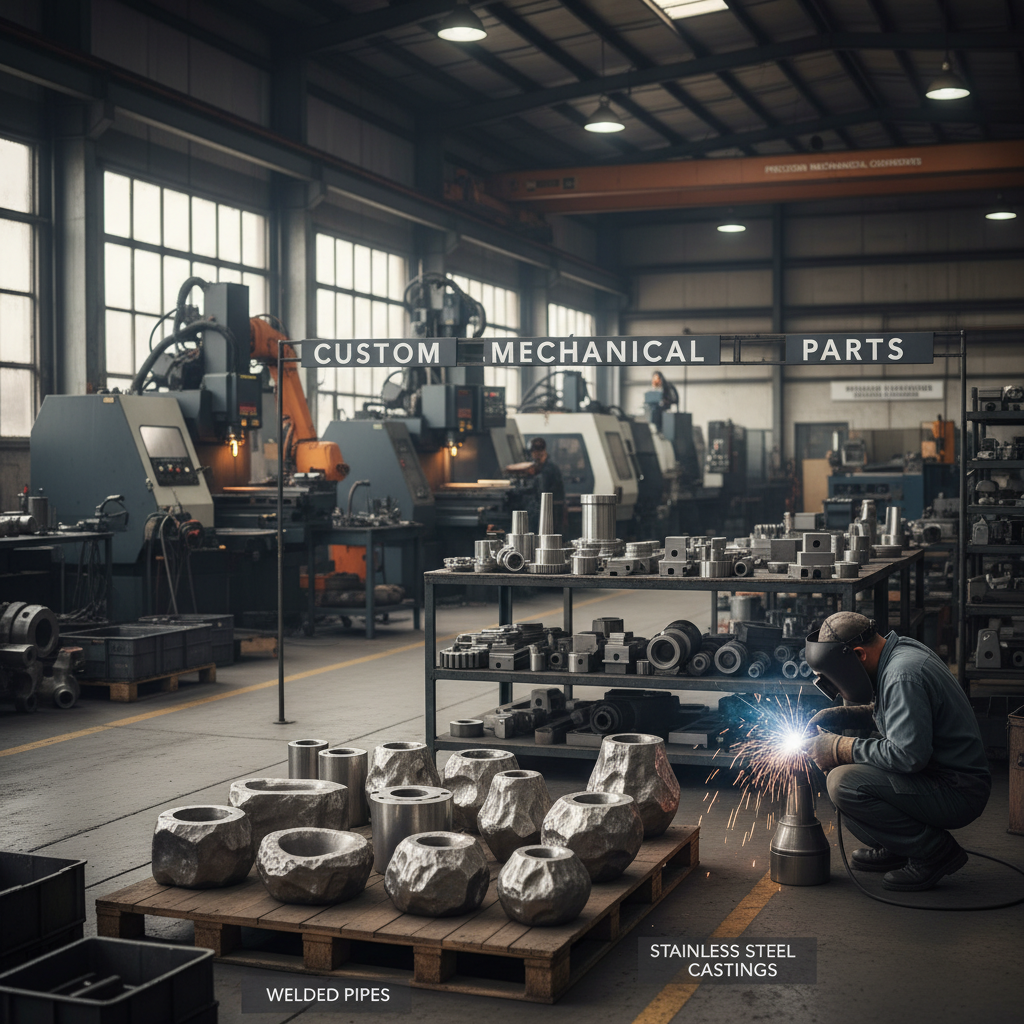
In the complex landscape of modern industrial manufacturing, a comprehensive mechanical parts catalog serves as more than just a list of components; it is the blueprint for operational efficiency. By consolidating technical specifications, material grades, and dimensional data into a single accessible resource, companies can drastically reduce procurement lead times and eliminate the costly errors associated with incorrect part selection.
Globally, the demand for precision-engineered components—ranging from aluminium bars and copper foils to complex assembled parts—has surged as automation and robotics redefine the factory floor. A well-structured mechanical parts catalog ensures that engineers and procurement officers can synchronize their requirements with the actual capabilities of the manufacturer, fostering a seamless transition from design to production.
Understanding the nuances of a professional component directory allows businesses to optimize their supply chains, ensuring that every transmission part or machined component meets the rigorous ISO standards required for safety and longevity. This guide explores how a detailed mechanical parts catalog acts as a catalyst for industrial innovation and reliability.
Global Industrial Significance of Component Directories
On a global scale, the precision of a mechanical parts catalog directly impacts the stability of international trade in metal products. With the rise of Industry 4.0, the ability to source specific materials like continuous cast iron bars or high-grade copper sheets across borders requires a universal technical language. According to ISO standards, standardization in part documentation reduces logistical friction and lowers the risk of machine failure in critical infrastructure.
The challenge many manufacturers face is the "specification gap"—where the requested part does not align with the physical reality of the manufactured item. A detailed catalog bridges this gap by providing empirical data, tolerance levels, and material certifications, ensuring that a transmission part ordered in Europe fits perfectly into a machine assembled in Southeast Asia.
Defining the Modern Mechanical Parts Catalog
In simple terms, a mechanical parts catalog is a comprehensive technical encyclopedia of a manufacturer's offerings. It transcends a mere price list by integrating CAD drawings, material properties (such as tensile strength and hardness), and application guides for everything from sheet metal parts to complex welded tubes. It serves as the primary communication tool between the design engineer and the fabrication specialist.
Beyond the technicalities, these catalogs play a vital role in humanitarian and emergency industrial needs. In scenarios such as repairing critical water infrastructure or restoring power grids in remote regions, having access to a standardized catalog allows for the rapid identification of interchangeable parts, preventing prolonged downtime in life-sustaining systems.
Modern catalogs have evolved from static printed booklets into dynamic digital assets. These digital versions allow for real-time updates on material availability, integrated 3D models for virtual prototyping, and direct links to procurement systems, making the mechanical parts catalog an active part of the product lifecycle management (PLM) process.
Core Pillars of Part Specification and Quality
The first pillar of any high-quality mechanical parts catalog is Material Integrity. Whether the component is an aluminium bar or a complex casting part, the catalog must clearly state the alloy grade and the heat treatment process used. This ensures that the part can withstand the specific thermal and mechanical stresses of its intended environment.
Dimensional Precision and Tolerance are equally critical. In the world of machining parts, a difference of a few microns can be the difference between a perfect fit and a catastrophic failure. A professional mechanical parts catalog provides explicit tolerance ranges, ensuring that engineers can design their assemblies with confidence.
Lastly, Scalability and Versatility define the utility of the directory. A comprehensive catalog doesn't just offer a single size; it provides a spectrum of options across various series, allowing clients to scale their production from prototypes using single sheet metal parts to mass-market implementation using thousands of assembled parts.
Strategic Applications Across Global Industries
The practical application of a mechanical parts catalog spans diverse sectors. In the aerospace industry, for instance, the rigorous selection of aluminium alloys and machining parts is governed by strict safety catalogs. Similarly, in the automotive sector, the ability to quickly source transmission parts and welded tubes from a verified catalog is essential for maintaining Just-In-Time (JIT) manufacturing workflows.
In remote industrial zones, such as mining operations in the Andes or oil rigs in the North Sea, the catalog becomes a lifeline. When a critical component fails, engineers rely on the mechanical parts catalog to identify exact replacements or suitable alternatives that can be airlifted to the site, minimizing millions of dollars in potential production losses.
Efficiency Ratings of Mechanical Parts Catalog Sourcing Methods
Long-term Value of Standardized Part Selection
The long-term value of utilizing a standardized mechanical parts catalog manifests in significantly reduced operational costs. By adhering to cataloged standards, companies avoid the "customization trap"—the expensive process of designing a unique part when a standard, high-quality catalog part would suffice. This not only lowers the initial purchase price but also simplifies future maintenance.
Beyond the financial aspect, there is a profound human element of trust and safety. When a technician installs a part from a verified mechanical parts catalog, they are relying on the manufacturer's guarantee of material strength and precision. This reliability reduces workplace accidents and ensures that industrial machinery operates within its safe design parameters, preserving the dignity and safety of the workforce.
Future Trends in Digital Component Sourcing
The future of the mechanical parts catalog is inextricably linked to the Digital Twin concept. We are moving toward a reality where the catalog is not a separate document but an integrated layer of the machine's digital twin. When a part wears out, the machine will automatically reference the catalog, identify the necessary replacement—such as a specific copper foil or transmission gear—and trigger a purchase order.
Sustainability is also reshaping how these directories are structured. Future catalogs will likely include "Green Specifications," detailing the carbon footprint of the aluminium bar production or the recyclability of the assembled parts. This allows companies to meet stringent ESG (Environmental, Social, and Governance) goals by selecting components with the lowest environmental impact.
Furthermore, the integration of AI-driven search within the mechanical parts catalog will allow users to upload a photo of a broken part and receive an instant match from the database. This fusion of computer vision and technical documentation will eliminate manual searching and drastically speed up the repair cycle.
Overcoming Common Sourcing Challenges
Despite the benefits, many firms struggle with "catalog bloat," where outdated parts remain in the directory, leading to procurement errors. The solution lies in the implementation of dynamic version control. By treating the mechanical parts catalog as a living document with clear revision histories, manufacturers can ensure that clients always access the most current specifications.
Another challenge is the language barrier in global procurement. Technical terms for "machining parts" or "welded tubes" can vary by region. Professional catalogs overcome this by utilizing standardized nomenclature (such as ISO or DIN standards) and providing multi-lingual technical glossaries, ensuring that a specification in English is interpreted identically in Mandarin or German.
Finally, the gap between a catalog's theoretical specifications and real-world performance can be bridged through the inclusion of "Application Case Studies." By showing how a specific part from the mechanical parts catalog performed in a high-pressure environment, manufacturers provide empirical proof of quality that goes beyond a simple data sheet.
Comparative Analysis of Mechanical Part Categories and Sourcing Metrics
| Part Category |
Precision Requirement |
Typical Lead Time |
Catalog Criticality Score |
| Aluminium Bar/Sheet |
Moderate |
Short |
6/10 |
| Machining Parts |
Extreme |
Medium |
10/10 |
| Transmission Parts |
High |
Medium |
9/10 |
| Casting Parts |
Moderate |
Long |
8/10 |
| Welded Tubes |
Low-Moderate |
Short |
7/10 |
| Assembled Parts |
High |
Long |
9/10 |
FAQS
A parts list is typically a simple inventory of components used in a specific machine. In contrast, a mechanical parts catalog provides comprehensive technical data, including material properties, tolerances, available sizes, and application guides, making it a tool for both design and procurement rather than just inventory tracking.
By utilizing a standardized mechanical parts catalog, engineers can select pre-existing, verified components instead of designing custom parts from scratch. This eliminates expensive custom tooling and reduces lead times, as catalog parts are often produced in higher volumes and maintained in stock.
Yes, high-tier catalogs often link directly to material certifications or provide the specific alloy grades (e.g., 6061 Aluminium) and ISO standards the parts adhere to. This is critical for industries like aerospace or medical device manufacturing where traceability and material purity are non-negotiable.
Look for clear dimensional drawings, explicit tolerance ranges, and a documented revision history. A reliable mechanical parts catalog will also specify the testing methods used to verify the parts, such as hardness tests or ultrasonic inspections for welded tubes.
Digital catalogs now integrate CAD files (like STEP or IGES), allowing engineers to drop a part directly into their 3D assembly to check for interference before ordering. This prevents the "trial and error" phase of procurement and ensures 100% fitment upon delivery.
In many cases, yes. Catalog parts are often designed to meet a wide range of industrial applications and are tested against a variety of stress scenarios. As long as the part's specifications in the mechanical parts catalog align with your operational requirements, they offer a reliable, cost-effective alternative to custom engineering.
Conclusion
In conclusion, the mechanical parts catalog is an indispensable asset in the modern industrial toolkit. By transforming raw technical data into a structured, accessible resource, it minimizes procurement errors, optimizes production timelines, and ensures that every component—from a simple aluminium sheet to a complex transmission gear—meets the highest standards of precision and safety.
As we move toward a future of AI-driven manufacturing and sustainable sourcing, the role of the catalog will only expand, evolving from a static reference to an intelligent, integrated system. For businesses looking to scale their operations and maintain a competitive edge in the global metal products market, investing in a high-quality, standardized part sourcing strategy is not just an option—it is a necessity for long-term reliability. Visit our website: www.hmiecmsp.com