Cast iron, a group of iron alloys with a high carbon content (typically 2% to 4%), stands as a cornerstone of modern engineering and manufacturing. Its versatility, stemming from different types of cast iron possessing unique properties, makes it indispensable across diverse industries. Understanding these variations – from the common gray cast iron to the more specialized ductile, white, and malleable cast irons – is crucial for selecting the optimal material for specific applications. Globally, the demand for cast iron remains strong, driven by infrastructure development, automotive production, and the need for robust and cost-effective components.
The significance of different types of cast iron extends beyond purely industrial applications. Historically, it's been fundamental to societal progress, forming the basis for tools, machinery, and infrastructure. Today, innovations in cast iron production continue to address challenges in sustainability and performance. From its role in water pipelines to its contribution to renewable energy components, cast iron impacts various facets of daily life. The sheer volume of cast iron produced annually—hundreds of millions of tons worldwide—underscores its importance to the global economy.
The benefits of a thorough understanding of different types of cast iron are multifaceted. Engineers can optimize designs, manufacturers can enhance production processes, and ultimately, consumers benefit from more durable and reliable products. Recognizing the specific strengths and weaknesses of each cast iron type allows for targeted material selection, minimizing costs, maximizing efficiency, and ensuring long-term performance in demanding environments. This knowledge empowers informed decision-making throughout the entire product lifecycle.
Introduction to Different Types of Cast Iron
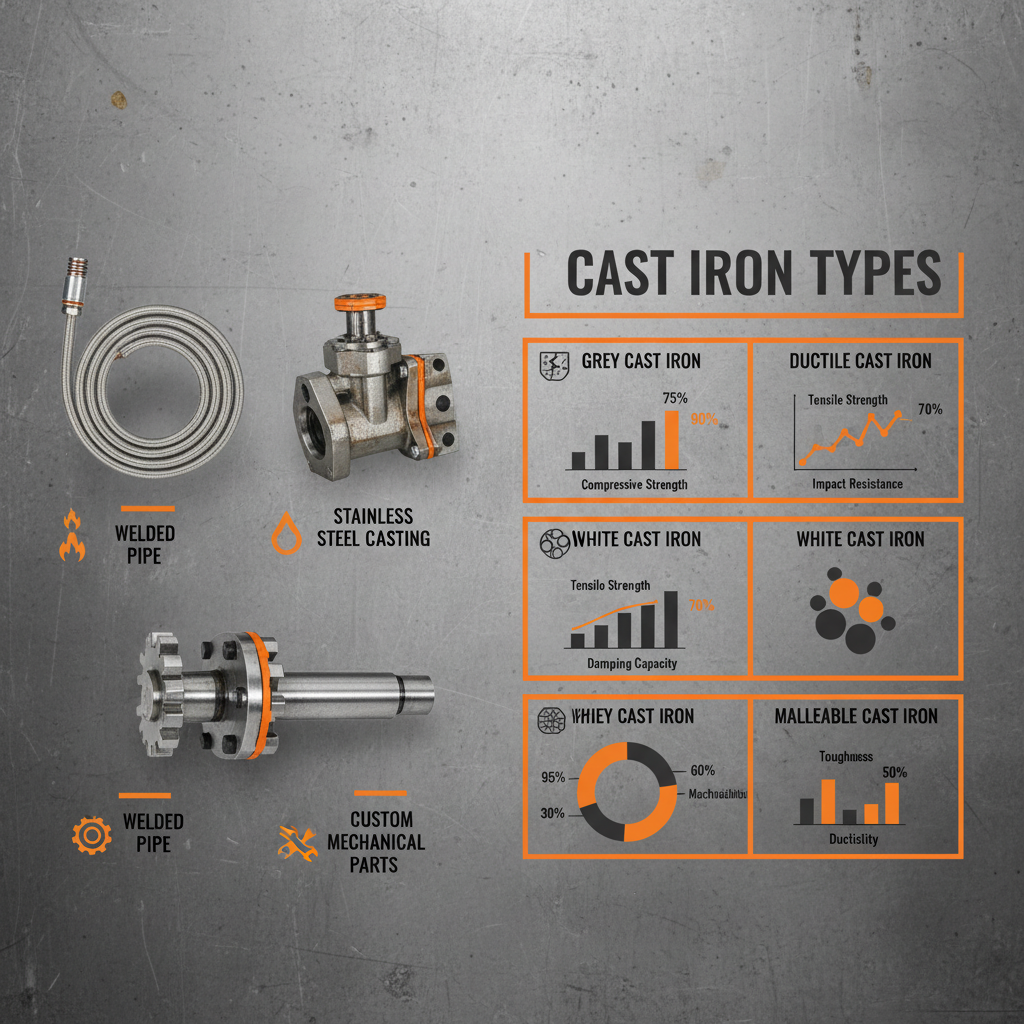
Different types of cast iron aren’t a single material, but rather a family of ferrous alloys categorized by their microstructure and resulting properties. Gray cast iron, known for its graphite flakes, offers excellent damping capacity and machinability, making it ideal for engine blocks and machine bases. Ductile cast iron, achieved through magnesium treatment, exhibits superior strength and ductility, making it suitable for pipes, automotive components, and heavy-duty applications.
Understanding the nuances between these types—and others like white cast iron and malleable cast iron—is critical for engineers and manufacturers. The choice of cast iron directly impacts a product’s performance, durability, and cost-effectiveness. Each variety represents a tailored solution to specific engineering challenges, and selecting the right type requires a comprehensive understanding of their individual characteristics and limitations.
Defining Different Types of Cast Iron
At its core, cast iron is an iron alloy with a carbon content exceeding 2%, unlike steel, which typically contains less than 2% carbon. The presence of silicon, manganese, sulfur, and phosphorus further modifies its properties. Different types of cast iron are differentiated by the form in which the carbon exists within the metal matrix. This microstructure – whether it’s graphite flakes (gray iron), spheroids (ductile iron), or cementite (white iron) – dictates the material’s strength, ductility, hardness, and machinability.
The process of solidification plays a vital role in determining the final microstructure. Cooling rate, composition, and the presence of specific additives all influence how carbon precipitates out of the molten iron. For instance, adding magnesium encourages the formation of spheroidal graphite in ductile iron, while rapid cooling favors the formation of cementite in white cast iron. These subtle variations create a wide range of materials suitable for incredibly diverse applications.
This makes cast iron uniquely adaptable, bridging the gap between the low cost of basic iron alloys and the superior performance of more expensive materials like steel. Its continued relevance in modern industry is a testament to its inherent versatility and the ongoing innovations in its production and application.
Key Characteristics of Cast Iron
One crucial characteristic of different types of cast iron is its excellent compressive strength, making it ideal for applications involving significant static loads. Gray cast iron, in particular, excels in this area. Another key attribute is its inherent damping capacity, meaning it effectively absorbs vibrations. This makes it a preferred material for machine tool bases and engine blocks where noise and vibration reduction are critical.
Machinability is another noteworthy characteristic. Gray cast iron's graphite flakes act as chip breakers, simplifying machining operations and reducing tool wear. However, ductility varies significantly across different cast iron types. Ductile cast iron, as the name suggests, exhibits much higher ductility than gray cast iron, making it more resistant to fracture and impact. Cost-effectiveness is also a significant advantage. Compared to many other engineering materials, cast iron is relatively inexpensive to produce.
Finally, cast iron exhibits good wear resistance, particularly when alloyed with elements like chromium or nickel. The ability to easily cast complex shapes, minimizing machining requirements, further contributes to its efficiency and cost savings. The specific characteristics that stand out depend heavily on the exact composition and microstructure of the chosen cast iron type.
Global Applications of Cast Iron
The applications of different types of cast iron are remarkably broad and span nearly every industry. In the automotive sector, gray cast iron remains prevalent in engine blocks, cylinder heads, and brake rotors due to its damping capacity and wear resistance. Ductile cast iron is used extensively in suspension components, crankshafts, and differential housings where higher strength and ductility are required.
The construction industry relies heavily on cast iron for pipes, fittings, and manhole covers. Its corrosion resistance and durability make it an ideal material for underground infrastructure. Similarly, in the water and wastewater treatment sectors, cast iron pipes provide long-lasting and reliable conveyance systems. Furthermore, in renewable energy applications, cast iron components are finding increasing use in wind turbine housings and hydroelectric power plant components.
Comparative Performance of Different Types of Cast Iron
Advantages and Long-Term Value
The advantages of utilizing different types of cast iron extend beyond initial cost savings. The inherent durability and longevity of cast iron components minimize the need for frequent replacements, reducing lifecycle costs. Its recyclability contributes to sustainable manufacturing practices, aligning with growing environmental concerns. The material’s ability to be cast into complex shapes reduces the need for extensive machining, saving time and resources.
Furthermore, the predictable behavior of cast iron under load provides engineers with a high degree of confidence in design and performance. This reliability translates into enhanced safety and reduced risk of failure. In essence, choosing the appropriate type of cast iron isn't merely a material selection decision; it’s an investment in long-term value, sustainability, and operational efficiency.
Future Trends in Cast Iron Technology
Several exciting trends are shaping the future of cast iron technology. Research into advanced alloying elements and heat treatment processes is continually improving the mechanical properties of cast iron, expanding its application envelope. The adoption of digital twin technology and predictive maintenance strategies is enabling optimized performance and extended service life of cast iron components.
Furthermore, the development of more sustainable casting processes, including the use of recycled materials and reduced energy consumption, is gaining momentum. The integration of cast iron into hybrid material systems, combining its strengths with those of other materials like composites, represents another promising avenue for innovation.
These advancements will cement cast iron’s position as a vital engineering material for years to come, adapting to the evolving demands of modern industry and contributing to a more sustainable future.
Challenges and Solutions in Cast Iron Production
Despite its many advantages, cast iron production faces certain challenges. Maintaining consistent quality and minimizing defects, such as porosity and shrinkage, requires stringent process control. The inherent brittleness of some cast iron types can limit their use in applications requiring high impact resistance. Environmental concerns related to emissions from foundries also necessitate continuous improvement in pollution control technologies.
However, innovative solutions are addressing these issues. Advanced casting simulation software allows for optimized mold designs and process parameters, reducing defects and improving material properties. Alloying with elements like magnesium and cerium enhances ductility and toughness. The implementation of cleaner production technologies, such as electric arc furnaces and improved filtration systems, minimizes environmental impact.
Continued research and development, coupled with a commitment to sustainable practices, will further overcome these challenges and unlock the full potential of different types of cast iron.
Overview of Cast Iron Production and Performance Metrics
| Cast Iron Type |
Production Cost (Scale 1-10) |
Tensile Strength (MPa) |
Typical Applications |
| Gray Cast Iron |
2 |
200-400 |
Engine Blocks, Machine Bases |
| Ductile Cast Iron |
5 |
400-800 |
Pipes, Automotive Components |
| White Cast Iron |
4 |
600-1000 |
Wear-Resistant Linings |
| Malleable Cast Iron |
6 |
300-600 |
Pipe Fittings, Automotive Parts |
| Alloyed Cast Iron (Ni-Resist) |
8 |
500-900 |
Corrosion-Resistant Valves |
| Compacted Graphite Iron (CGI) |
7 |
600-1200 |
Diesel Engine Blocks |
FAQS
Gray cast iron contains graphite in flake form, leading to good damping and machinability but lower tensile strength. Ductile cast iron, achieved through magnesium treatment, has graphite in spheroidal form, resulting in significantly higher tensile strength, ductility, and impact resistance. This makes ductile iron preferable for applications requiring greater mechanical integrity, like pipes and automotive components.
Carbon content is a primary determinant of cast iron's properties. Higher carbon content generally increases hardness and wear resistance but reduces ductility and weldability. The form of carbon (flakes, spheroids, cementite) is even more critical, as it dictates the material's microstructure and, consequently, its overall performance characteristics. Different types of cast iron are created through manipulating the carbon content and its form.
Cast iron can corrode, particularly in humid or corrosive environments. Corrosion occurs due to the oxidation of iron. Mitigation strategies include applying protective coatings (paint, epoxy), galvanizing, using corrosion-resistant alloys (like nickel-alloyed cast iron), and cathodic protection. Selecting an appropriate cast iron type with inherent corrosion resistance is also crucial.
While brittle, white cast iron excels in wear resistance due to its hard cementite structure. It is therefore used for applications requiring high abrasion resistance, such as rolling mill rolls, crusher jaws, and wear plates in mining and construction equipment. Its brittleness is often a trade-off accepted for superior wear performance in these specific contexts.
Malleable cast iron is produced by heat-treating white cast iron. This process converts the cementite to temper carbon, resulting in a material with improved ductility and machinability compared to white cast iron. It offers good strength, impact resistance, and is relatively inexpensive, making it suitable for applications like pipe fittings, automotive components, and agricultural equipment.
Yes, cast iron is highly recyclable, making it a sustainable material choice. Recycling cast iron reduces the demand for virgin iron ore, conserves energy, and minimizes landfill waste. It also lowers greenhouse gas emissions associated with mining and processing new materials. Recycling is a crucial aspect of the circular economy in the metals industry.
Conclusion
In conclusion, different types of cast iron represent a versatile and essential family of engineering materials. From the foundational gray cast iron to the high-strength ductile iron and specialized alloys, each type offers unique properties tailored to specific applications. Understanding these differences is vital for optimizing designs, enhancing performance, and minimizing costs across a wide range of industries. Their inherent properties and cost-effectiveness ensures their continued relevance in numerous sectors.
Looking ahead, continued innovation in alloying, processing, and sustainability will further expand the capabilities and applications of cast iron. Embracing digital technologies and focusing on responsible production practices will solidify its role as a cornerstone of modern engineering for generations to come. To learn more about the diverse range of cast iron solutions available, visit our website: www.hmiecmsp.com